Lees deze gids in het Nederlands →
New here? Start with Why isn’t Google indexing my site? →
Related: Crawled vs. Discovered →
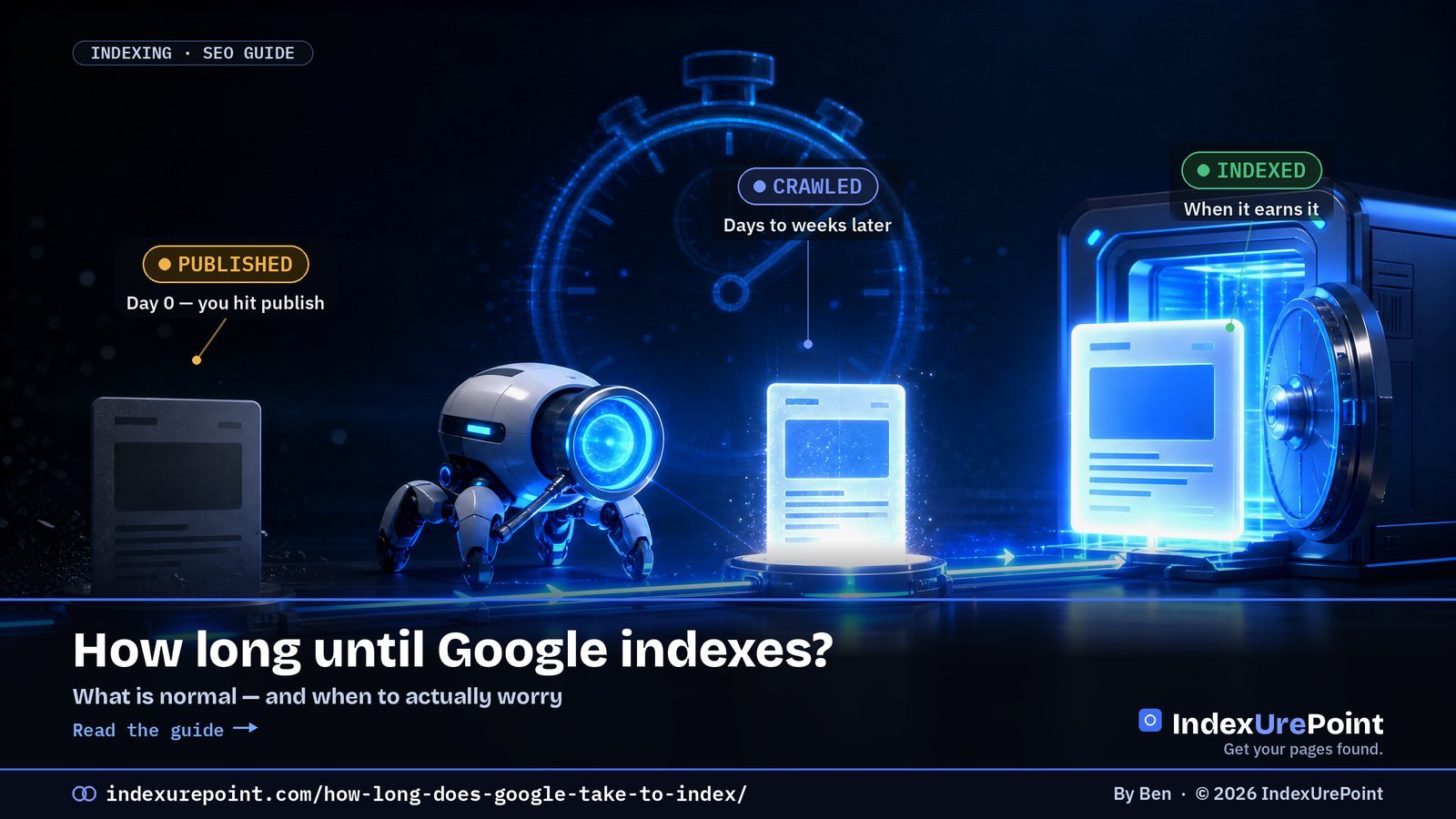
On an established, healthy site a new, internally linked page is usually indexed within a few hours to about a week; on a brand-new domain, expect days to several weeks — there is no fixed timer, only trust, links and quality.
- Indexing is three stages — discover, crawl, index — and the wait can happen at any of them.
- Google’s own guidance: crawling and indexing “can take anywhere from a few days to a few weeks.”
- The most reliable accelerator is an internal link from a strong, already-indexed page.
- “Request indexing” queues a URL once; practitioners note the ~10/day limit and that repeat submissions change nothing.
- Worry only when a well-linked, valuable page on an established site stays out past 3–4 weeks.
On an established, healthy site, a new page that’s linked internally is usually indexed within a few hours to about a week.
On a brand-new domain, expect days to several weeks — sometimes longer — while Google learns to trust the site.
There’s no fixed timer. Google indexes a page when it has crawled it and decided it’s worth keeping. Speed follows trust, links, and quality — not the clock.
The three stages (and where time goes)
Typical timeframes
How to get indexed faster
When to actually worry
FAQ
The three stages — and where the time actually goes
“Indexing” isn’t one step. A page moves through three, and the wait can happen at any of them:
Google finds the URL
The wait here: hours to days. Speed up with a sitemap and internal links from pages Google already crawls.
Googlebot fetches it
The wait here: hours to weeks, set by crawl budget and priority. Fast, error-free servers help.
The third stage — index — is where Google decides whether the fetched page is worth keeping. A thin or duplicate page can be crawled quickly and still never make it in. That’s a quality decision, not a speed one.
Typical timeframes (what “normal” looks like)
- Established site, well-linked page: a few hours to ~1 week.
- Established site, weakly-linked or deep page: 1–4 weeks.
- Brand-new domain: days to several weeks for the first pages, faster once the site earns trust.
- Thin, duplicate, or low-value page: may never index, regardless of time. Fix the page, not the wait.
Anyone promising an exact number is guessing. Google’s own line is that crawling and indexing “can take anywhere from a few days to a few weeks,” and it depends heavily on the site. Treat ranges as expectations, not deadlines.
| Situation | Typical time to indexed | Main lever |
|---|---|---|
| Established site, well-linked page | Hours to ~1 week | Keep doing what works |
| Established site, deep or weakly linked page | 1–4 weeks | Internal links, click depth |
| Brand-new domain | Days to several weeks | Publish + earn links, patience |
| Thin or duplicate page | Possibly never | Improve or consolidate content |
How to get indexed faster (the levers that actually move it)
- Link the new page internally from strong, already-indexed pages. This is the single most reliable accelerator — it pulls the URL into the crawl queue.
- Keep it in your sitemap and make sure the sitemap is submitted in Search Console.
- Use URL Inspection → Request indexing once, for a genuinely ready page. Once — not daily.
- Fix crawl waste. If Googlebot burns budget on parameter URLs, redirects, or 5xx errors, your good pages wait longer.
- For Bing, use IndexNow. It notifies Bing and other engines the moment you publish — see what IndexNow is. (Google doesn’t use it.)
- Make the page worth keeping. Unique, useful content indexes faster and stays indexed. Speed is downstream of quality.
When to actually worry
Worry when a well-linked, high-value page on an established site stays unindexed past 3–4 weeks. Before then, on a young domain especially, waiting is the correct move. Panic-submitting the same URL every day does nothing but raise your blood pressure. Check the status in Search Console: if it says Discovered, it’s a discovery/priority issue; if it says Crawled – currently not indexed, it’s a value issue.
Crawling comes first. Before Google can index a page it has to fetch it — see how often Google crawls a site, with real Crawl Stats from this site.
FAQ
Does “Request indexing” make it instant?
No. It moves the URL higher in the crawl queue, but Google still decides when to crawl and whether to index. It often helps within hours to days for a ready page; it does nothing for a thin one.
Why is my brand-new site taking so long?
New domains have little trust and few links, so Google crawls cautiously. Keep publishing useful pages and earning links; indexing speed improves as the site proves itself. Several weeks early on is normal.
My page was indexed, then disappeared. Why?
Google re-evaluates over time. A page can be dropped if it’s judged thin, duplicate, or lower-value than alternatives. Improve and strengthen it, then let Google recrawl.
Does publishing more often speed up indexing?
Indirectly. A site that regularly publishes useful content tends to get crawled more frequently — but frequency without quality doesn’t help. Consistency plus value is what earns faster crawls.
Does Google index faster at certain times?
No credible evidence supports publish-time tricks. Crawl frequency follows your site’s trust, health and update pattern, not the clock or day of the week.
Do social media shares speed up indexing?
Indirectly at best. Most social links are nofollow; the reliable path stays internal links, a sitemap and, for Bing, IndexNow.
Comments
3 responses to “How Long Does Google Take to Index a Page? (Realistic Timeframes)”
[…] On an established site, a genuinely valuable page usually indexes within days to two weeks once it’s linked internally. On a brand-new domain, several weeks is normal. Worry when a well-linked, high-value page stays stuck past ~3–4 weeks. See typical indexing timeframes. […]
[…] site and everything’s slow? That’s often normal — see how long Google takes to index before you […]
[…] Read this guide in English → […]